
Calhoun County Criminal Court Cases
Calhoun County uses two trial-court levels at the same Clerk’s office. Circuit Court in the Fourteenth Judicial Circuit hears felony prosecutions. Calhoun County Court hears misdemeanors, county-ordinance matters, and criminal traffic. The Clerk maintains the docket, filed papers, hearing record, judgment, sentence, and public financial entries for both levels.
The Fourteenth Judicial Circuit also covers Bay, Gulf, Holmes, Jackson, and Washington counties, but a Calhoun County criminal court case remains in the Calhoun Clerk system. State Attorney Larry Basford represents Florida in circuit prosecutions. The Public Defender serves a qualifying defendant after appointment. Neither office replaces the Clerk as custodian of the public case file.
Calhoun Felonies and Misdemeanors
The degree of the filed offense directs a Calhoun County criminal case to the right court. Florida uses degrees rather than letter classes. Capital, life, first-degree, second-degree, and third-degree felonies belong in Circuit Court. First-degree and second-degree misdemeanors belong in County Court. Criminal traffic also runs through County Court.
| Filed matter | Calhoun court | Ordinary maximum |
|---|---|---|
| First-degree felony | Circuit Court | 30 years, or life when a statute permits |
| Second-degree felony | Circuit Court | 15 years |
| Third-degree felony | Circuit Court | 5 years |
| First-degree misdemeanor | County Court | 1 year |
| Second-degree misdemeanor | County Court | 60 days |
These are general limits from Florida Statutes sections 775.082 and 775.083. The offense statute, mandatory minimums, enhancements, and reclassification rules may change exposure. Read the information and judgment instead of relying on a short degree code from booking.
Searching Calhoun County Case Records
The Clerk’s Online Court Records routing page is the main remote channel. Public access is free, while a secure agreement supports expanded role-based access for registered users, parties, business-party representatives, and attorneys. Exact vendor controls can change, so record the date of the search and preserve the full case number once found.
- Open the Clerk records search and choose the party-name or case-number route, then narrow to a criminal case type when that control appears.
- Search the surname first, add first and middle names, and try a known spelling variant only when legitimately known.
- Open the likely result and confirm court, case number, filing date, case type, and chronology before treating it as the right person.
- Read every charge and docket entry through the latest disposition, judgment, sentence, and financial entry.
- Call or visit Room 130 for a missing image, an older file, an ordinary copy, or a certified disposition.
| Field or control | Type | Required | Use |
|---|---|---|---|
| Search type | Tabs or menu | One mode | Choose party/name or case number |
| Last or business name | Text | Name mode | Use exact spelling, then variants |
| First name | Text | No | Narrows common names |
| Middle name | Text | No | Helps separate similar identities |
| Case number | Text | Case mode | Keep Clerk format and suffixes |
| Court or case type | Dropdown | No | Narrow to criminal categories |
| Date range | Date controls | No | Focus on a known filing period |
Calling Room 130 About Cases
The verified Calhoun County criminal-file counter is at the Calhoun County Courthouse, 20859 Central Avenue East, Room 130, Blountstown, Florida 32424. It is open Monday through Friday from 8:00 a.m. to 4:00 p.m. Central. Call 850-674-4545 for case-specific routing. The Clerk asks people with a court-case question to call instead of putting case facts into the general web form.
Calhoun Clerk Criminal Records
Address: 20859 Central Avenue East, Room 130, Blountstown, FL 32424
Phone: 850-674-4545
Hours: Weekdays, 8:00 a.m.-4:00 p.m. Central
Email: clerk@calhounclerk.com
Give staff the full case number when possible. State whether the request is for inspection, an ordinary copy, or a certified copy. Certification can matter for an FDLE correction or a sealing or expunction packet. The research did not locate a universal Calhoun copy or certification fee, so ask for a current estimate before ordering.
Inside a Calhoun County Case File
A Calhoun County criminal case file separates allegations, court events, and results. The most useful reading order is the case header, parties, each filed charge, docket chronology, disposition, judgment, and sentence. A web result can omit an image even though the document exists at the counter.
| Case Number & Court | Identifies the Calhoun division and the stable reference for calls, copies, payments, and later searches. |
|---|---|
| Charging Document | The information, complaint, or citation states what was filed, which can differ from the booking allegation. |
| Parties & Counsel | Names the State of Florida, defendant, and attorneys when public; a name alone is not identity proof. |
| Docket Entries | Lists dated filings and events such as arraignment, discovery, motions, pretrial conference, plea, trial, and judgment. |
| Hearing Dates | Shows scheduled event, judge, time, and location when public and entered. |
| Disposition & Judgment | May show nolle prosequi, dismissal, acquittal, adjudication withheld, or adjudication of guilt for each charge. |
| Sentence & Conditions | May list jail or prison, probation or community control, time served, fines, costs, and other ordered terms. |
Read Calhoun Dockets Chronologically
The docket is a timeline, not a verdict label. Start at the information or complaint and move forward by event date. A probable-cause filing or arraignment shows that the case advanced, but neither proves guilt. Motions and amended filings may change the legal issues before a plea or trial.
- Nolle prosequi
- The prosecutor discontinued that charge.
- Adjudication withheld
- The court withheld formal adjudication; it is not the same as a dismissal.
- Adjudicated guilty
- The court entered an adjudication of guilt.
- Closed
- An administrative case status that does not, by itself, identify the disposition.
- Capias
- A court command that may later be served, recalled, or addressed by a newer entry.
Note: Always read the newest Calhoun docket entry because a later order can change the effect of an earlier event.
How a Calhoun Criminal Case Moves
A case file starts when the prosecutor files an information or another charging instrument, or when a criminal citation opens the matter. Arraignment records the plea and sets the next stage. Pretrial work can include discovery, motions, conferences, and negotiation. The matter then ends through a plea, trial, dismissal, or other charge-specific action before judgment and any sentence.
Case flow: Charges Filed › Arraignment › Pretrial › Plea or Trial › Disposition › Sentencing
The Sheriff’s booking date may precede the case filing, and a citation may create a case without a county-jail booking. For the custody side of the sequence, use the Calhoun County arrest lookup. For the court result, keep reading the Clerk file through the final charge disposition.
Calhoun Booking and Filed Charges
A booking entry records the allegation and hold at intake. State Attorney review can produce a filed charge that is amended, reduced, enhanced, or declined. The Clerk’s information and charge history are therefore more authoritative for what Florida prosecuted than the original jail label.
FDLE maintains a third layer: a statewide criminal-history compilation based heavily on fingerprint-supported arrest cycles and reported dispositions. That record may lag the Calhoun docket. If a repository result is incomplete, the subject should obtain an FDLE Personal Review, identify the disputed cycle, and get a certified Calhoun disposition for the correction process.
Missing Calhoun Court Images
A missing image does not prove that a filing is absent. Online availability can depend on the user’s access role, document confidentiality, redaction, digitization, or system maintenance. The Clerk’s secure agreement provides registered-user, party, business-party, and attorney roles, each with different lawful access.
Call Room 130 with the case number and docket date. Ask whether the item can be inspected, sent electronically in its existing form, or copied. For older Calhoun County criminal court cases, ask about archival coverage and storage rather than assuming every paper-era image was digitized.
The official records-search source shows how Calhoun routes public and secure access. Its layout is pictured below so a reader can recognize the correct Clerk channel.
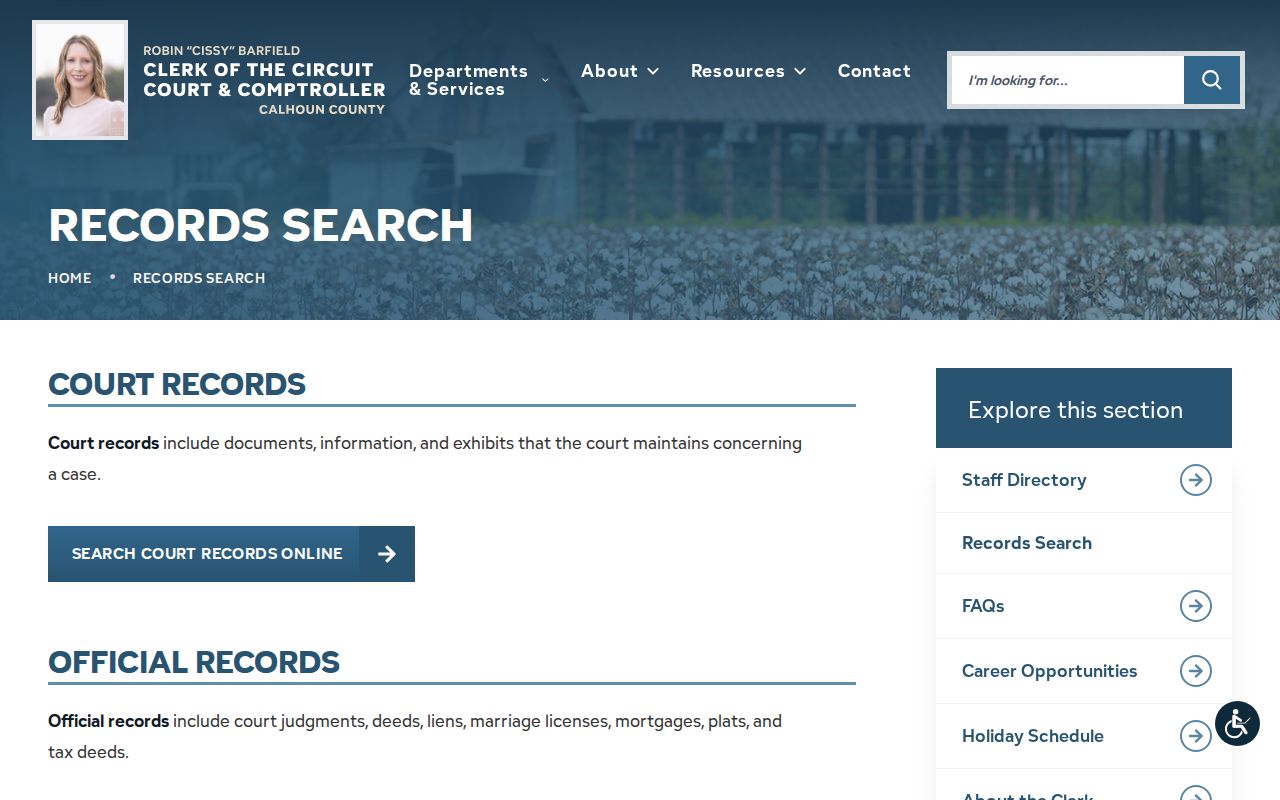
Use the live Clerk records-search page because controls and access notices can change after the image was captured.
Calhoun Case Record Access
Florida’s Constitution and Public Records Law favor access, but statutes, judicial rules, and court orders protect certain material. Juvenile matters, sealed or expunged cases, victim information, protected identifiers, and confidential images may be restricted. A paper file may be open even when anonymous online image access is limited.
If material is withheld, ask which law or order applies and whether a separable redacted version can be produced. Do not infer that no Calhoun County criminal case exists merely because a name search returns nothing. Check spelling, date range, court type, restricted status, and whether the filing belongs in another county or federal court.
Calhoun Clerk Access Channels
The Clerk provides more than one way to reach a Calhoun County criminal court case. Remote search is best for a first pass. The courthouse counter is best for inspection, certification, and a file that does not display online. Telephone is the preferred route for case-specific help, while email or the general contact form is better for non-case routing.
The Clerk’s official contact page shows the records-request route used when an online result is not enough. The captured page below is a visual aid, not a substitute for current instructions.
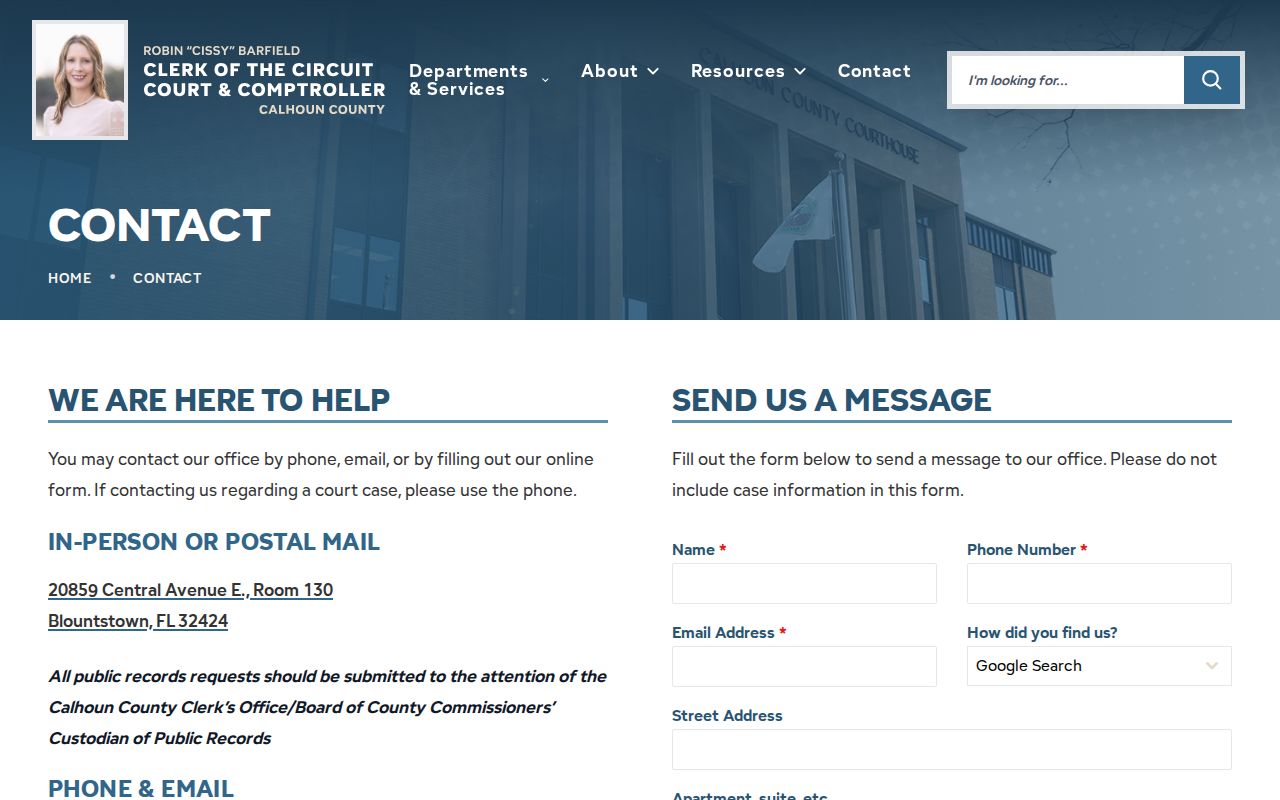
Open the current Clerk contact page for live routing, and keep private case facts out of the general web message.
The Clerk also groups court search, payments, and E-Notify on its official online-services page. E-Notify may send event reminders where supported, but it is not the case file and cannot replace the latest docket.
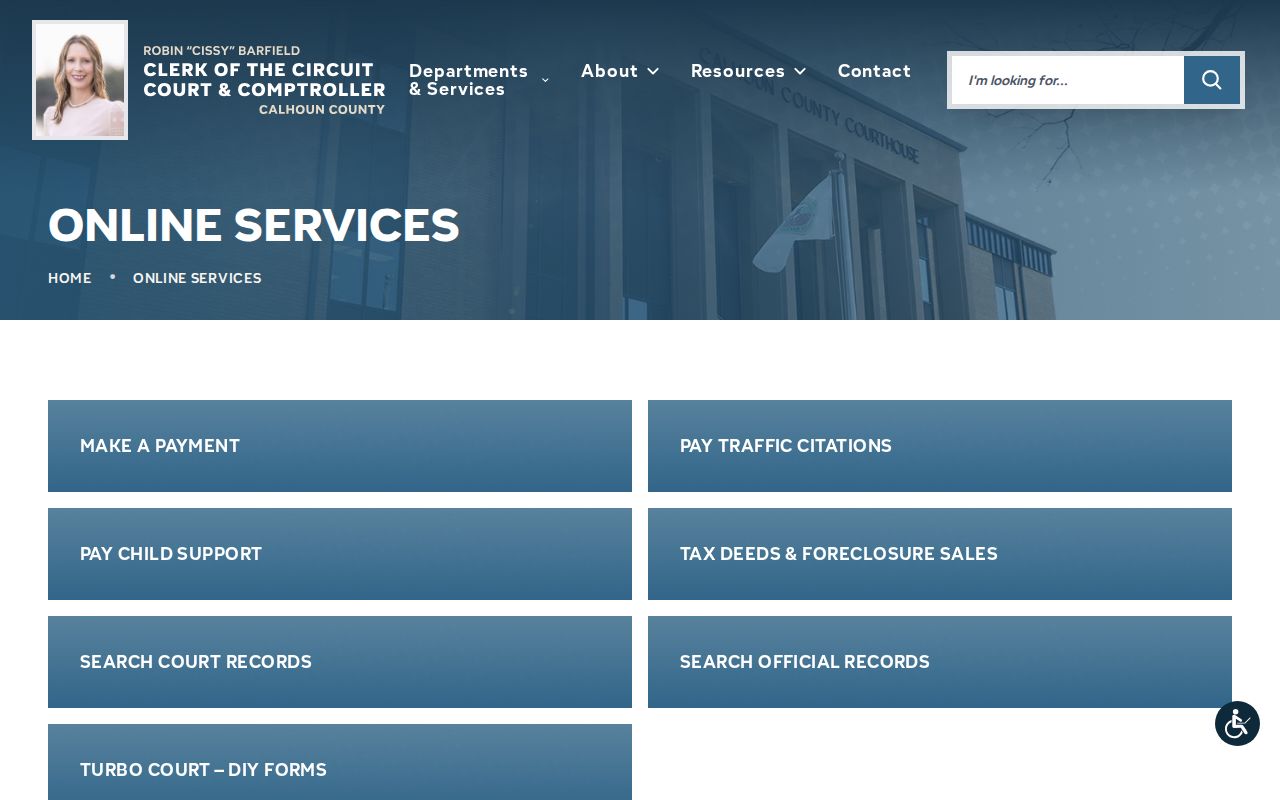
Check the live Calhoun Clerk online services before relying on a saved link or old screen.