
Checking Criminal History in Calhoun County
No single Calhoun County screen contains every police contact, booking, court filing, statewide arrest cycle, or correctional entry. Begin with the question the record should answer. The Calhoun Clerk records search is the best first stop for a filed criminal case. The Sheriff Jail Log and Arrest Report address recent local custody and arrest publication. The Florida Department of Law Enforcement, or FDLE, compiles statewide information reported to its repository. Each layer has a different time stamp and purpose.
Collect a full legal name, spelling variants, an approximate date, and any known case or agency number. A case number is stronger than a name. Do not confuse it with a Sheriff incident number, booking number, SID, or warrant number. Note the date of each search because a jail entry can change after release and a court docket can change after the State Attorney files or amends a charge.
- Search the Calhoun Clerk by party name or case number for filed felony, misdemeanor, and criminal-traffic cases.
- Check the Sheriff Jail Log and Arrest Report for current or recent local booking activity.
- Use FDLE CCH when a statewide Florida name-based compilation is needed.
- Open the source record and compare names, dates, agencies, case numbers, charges, and dispositions.
- Ask the Clerk for a certified disposition or use FDLE Personal Review when accuracy must be checked on your own record.
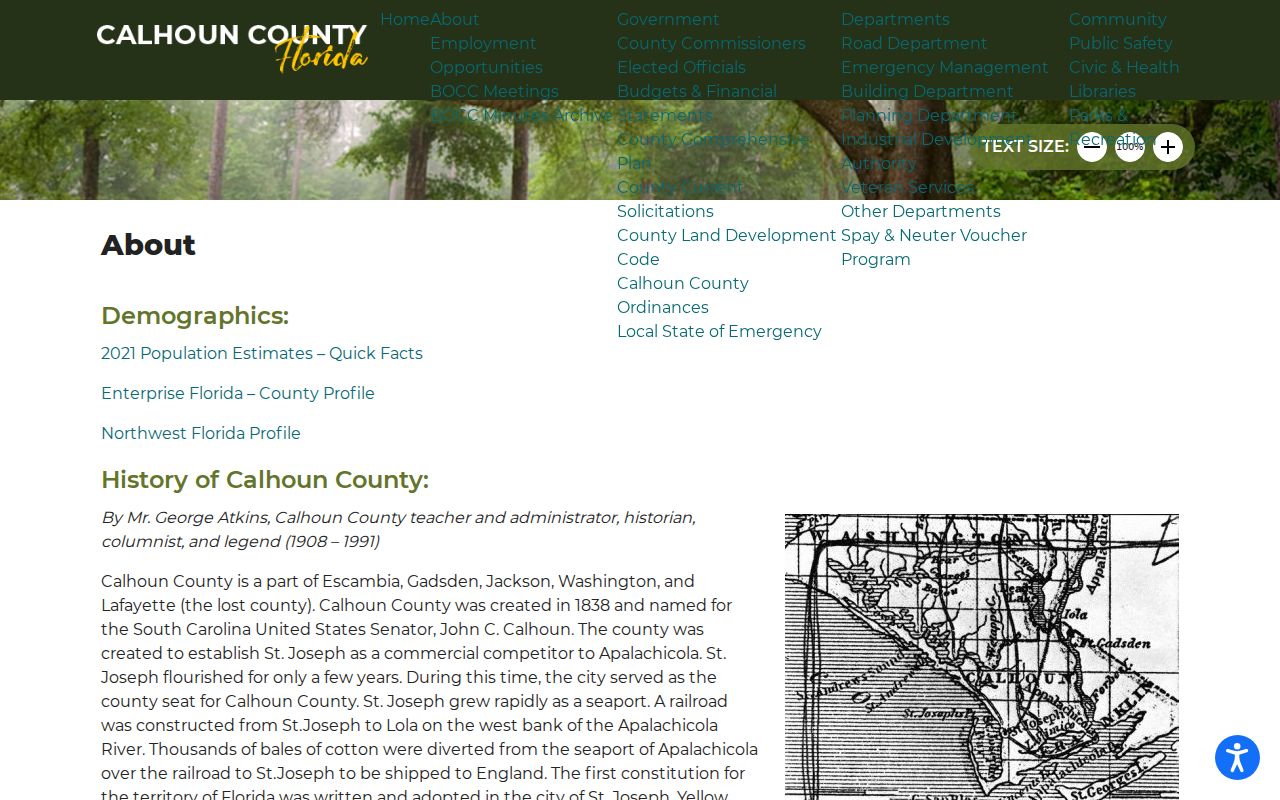
The official Calhoun County portal shows the county government and courthouse identity used for local records access.
That county source helps distinguish official offices from private search services and confirms where Calhoun County government information begins.
Two Calhoun County Record Counters
Calhoun County has two core public counters on Central Avenue East in Blountstown, but they hold different records. The Clerk of Circuit Court works from Room 130 at the courthouse, 20859 Central Avenue East. Its counter is open weekdays from 8:00 a.m. to 4:00 p.m. Central, and its phone is 850-674-4545. Ask there for case dockets, filed charges, judgments, sentences, certified dispositions, copy requests, and petitions in an existing court matter.
The Sheriff and Jail are at 20776 Central Avenue East, phone 850-674-5049. That office is the verified gateway for Sheriff incident reports, arrest reports, jail and booking entries, warrants, fingerprint-card availability, and local sex-offender registration questions. The Sheriff does not publish a separately labeled records-division page, so a caller should name the exact record sought. Calling the wrong nearby counter can create a false dead end.
Calhoun County Clerk
20859 Central Avenue E., Room 130
Blountstown, FL 32424
850-674-4545
Weekdays, 8:00 a.m.-4:00 p.m. Central
Calhoun County Sheriff and Jail
20776 Central Avenue E.
Blountstown, FL 32424-2276
850-674-5049
Call for the proper records custodian
The Calhoun County Sheriff website links the official jail and arrest channels.
The page identifies the local law-enforcement source, while the Clerk remains the source for the case that follows an arrest.
Florida Official Background Checks
FDLE Criminal Justice Information Services maintains Florida's central criminal-history repository. Its Computerized Criminal History Internet Search accepts a public name-based query. The official price is $24 plus a $1 card-processing fee. It searches Florida data reported to FDLE, not a complete nationwide fingerprint history. A candidate result still requires careful identity review because names alone can produce false matches or miss records filed under a variant.
For a review of your own state record, FDLE offers fingerprint-supported Personal Review without an FDLE fee. Ask the Sheriff about local fingerprint-card service, identification, appointments, and any rolling fee because no official source published those local terms. FDLE-approved Livescan providers serve authorized electronic checks, but no verified commercial Livescan center was found inside Calhoun County. The requesting agency must supply the correct ORI before an appointment. The FBI Identity History Summary is the separate federal fingerprint route for one's own nationwide record.
| Official product | Cost or access | Best use |
|---|---|---|
| FDLE CCH name search | $24 plus $1 card fee | Florida name-based reported history |
| FDLE Personal Review | No FDLE charge stated | Fingerprint review of your own Florida record |
| FDLE-approved Livescan | Provider-specific | Authorized electronic submission with correct ORI |
| FBI Identity History Summary | Verify current FBI fee | Your own federal fingerprint identity history |
The FDLE CCH interface is the official paid name-search product.
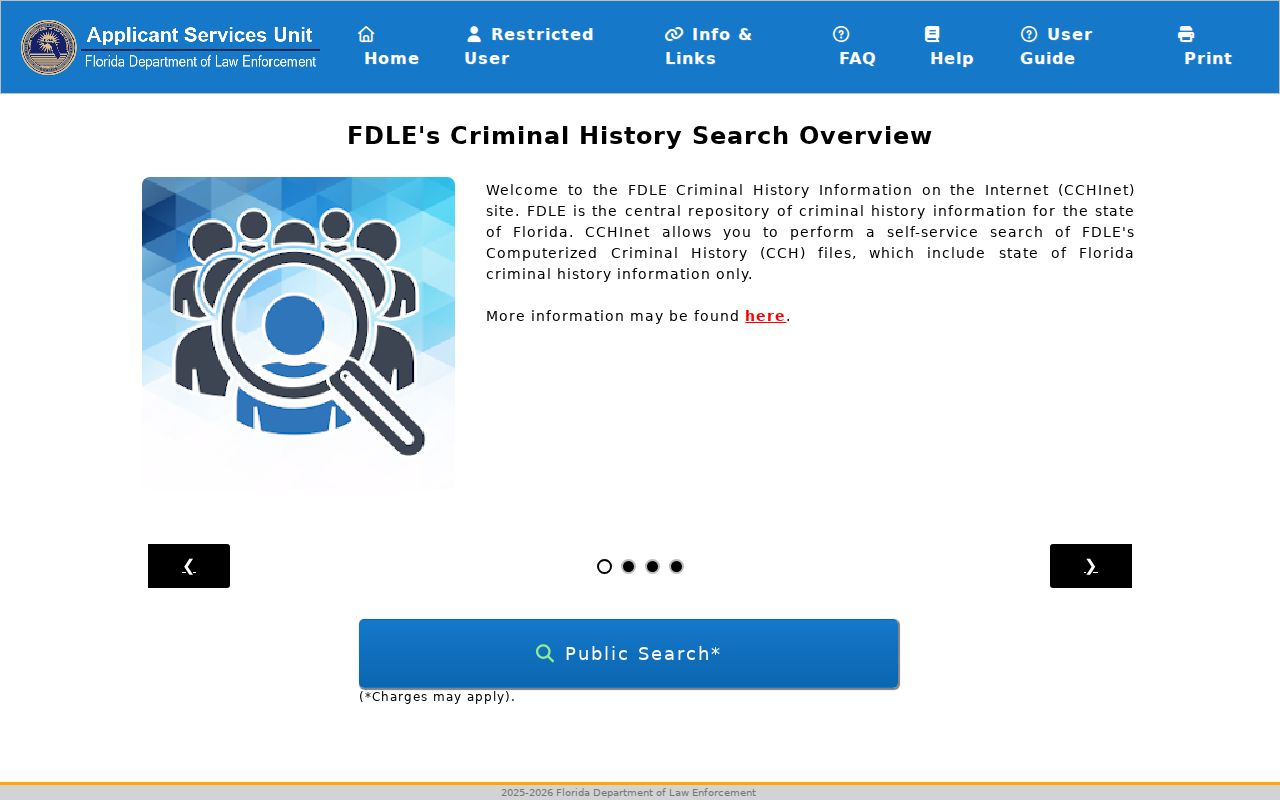
Its statewide result should be compared with the Calhoun County source files and never treated as fingerprint confirmation.
The FDLE criminal-history overview separates the public search, Personal Review, and other official Florida record channels.
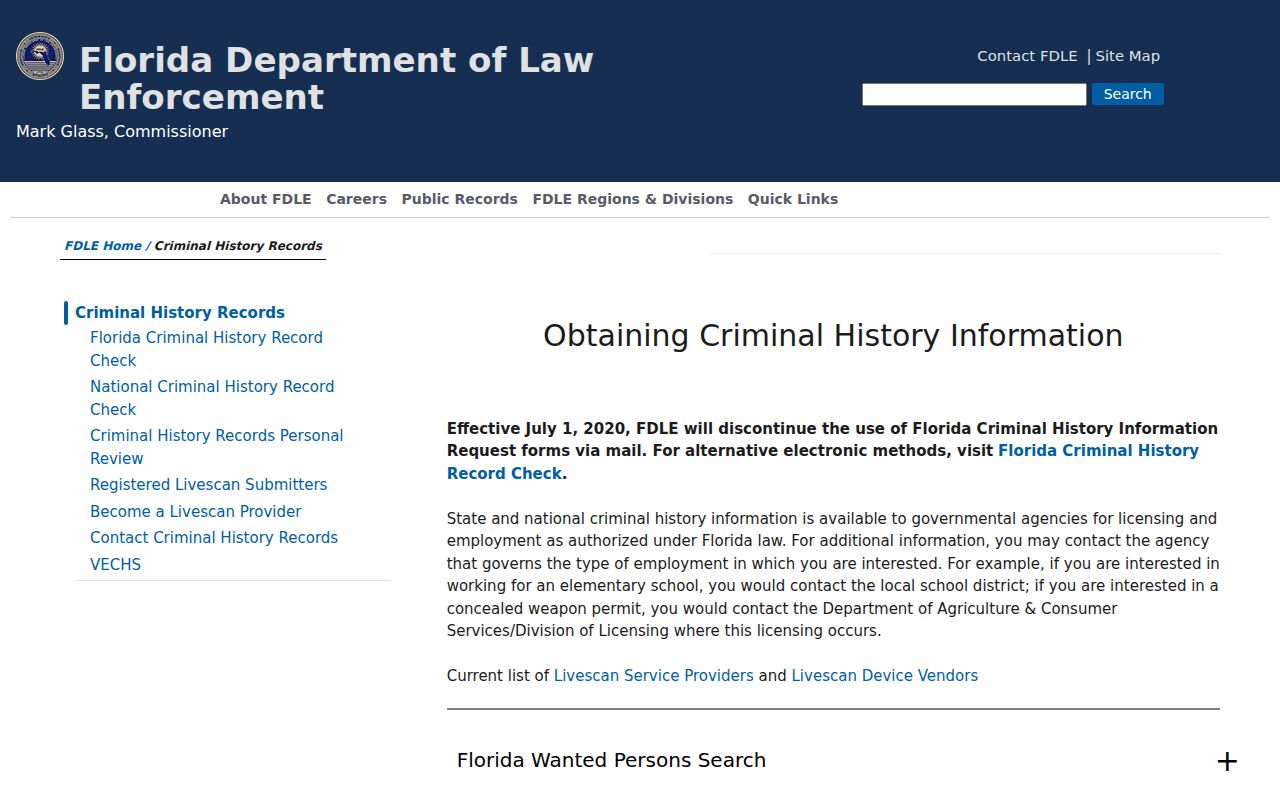
That overview is useful when a name search is not the right tool, especially for checking or correcting one's own repository record.
Calhoun County Court Search Fields
The Clerk's public online system offers party-name and case-number routes. A surname can locate possible cases, but a full case number is the most reliable key for later phone, counter, payment, copy, and correction work. Search controls may change with the vendor release. When a document image is absent, the docket can still show that it exists, and the Clerk can explain whether access level, confidentiality, redaction, or digitization limits apply.
| Field | Use | Practical point |
|---|---|---|
| Search type | Choose party/name or case number | Role-based modes may add options |
| Last or business name | Starts a name search | Try accurate spelling variants |
| First and middle name | Narrows candidates | Absence does not prove identity |
| Case number | Opens a known file | Keep zeros and division suffixes |
| Court type and date range | Limits broad results | Select criminal categories when offered |
The Calhoun Clerk homepage anchors the county's court record services.
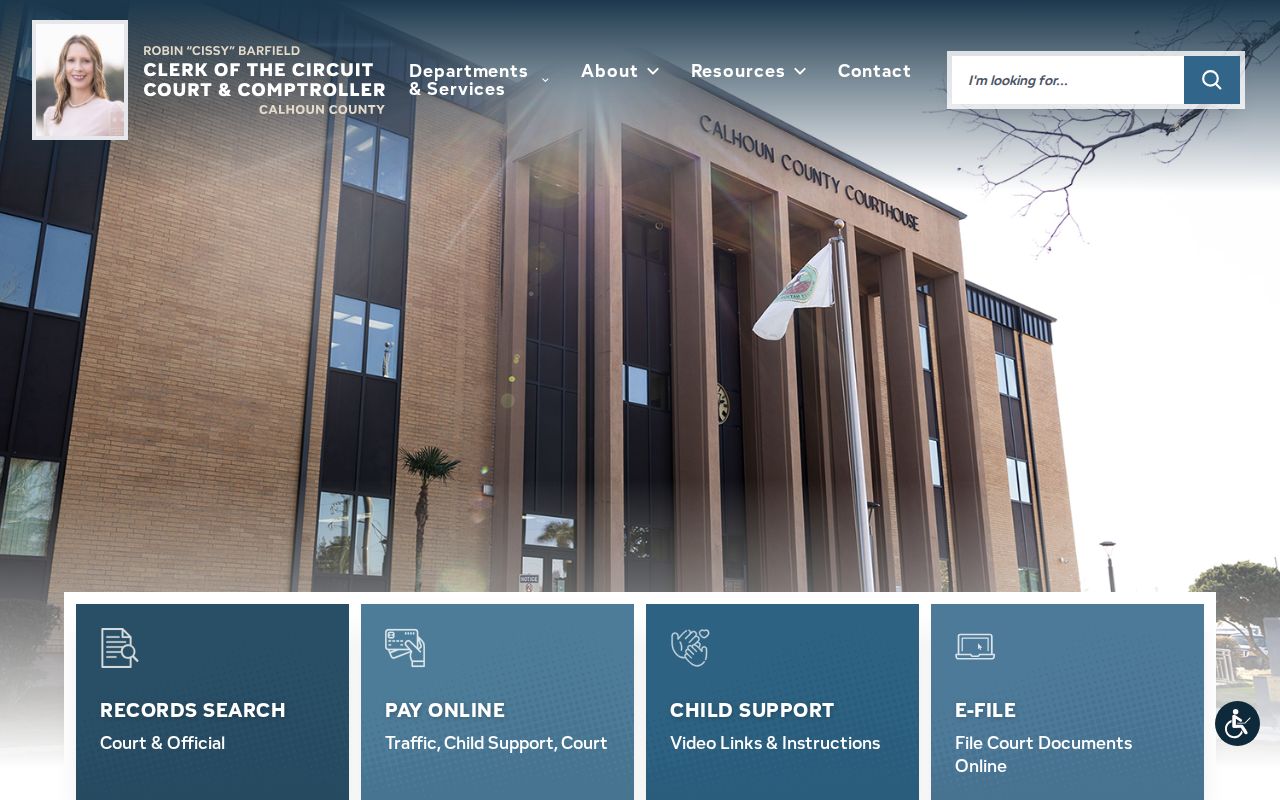
The Clerk also offers secure role-based access by agreement, but expanded access does not turn confidential material into a public record.
Criminal Record Types
A Calhoun County criminal record is not one document. The investigating agency writes the incident narrative. An arresting agency creates the arrest report. The Jail creates the booking entry. The State Attorney decides what to file, and the Clerk maintains the resulting case. FDLE later connects qualifying fingerprint-supported arrest cycles with reported dispositions. Florida Department of Corrections records begin to matter after a prison sentence or during state supervision.
- Incident report
- The originating agency's account of reported events, evidence, witnesses, and initial allegations.
- Booking record
- A jail intake and custody record that can show charges, bond, holds, and release data without proving guilt.
- Court case
- The Clerk's file of charging papers, docket events, hearings, disposition, judgment, sentence, and costs.
- FDLE criminal history
- A statewide compilation of arrest cycles and dispositions reported to the repository.
- Warrant or capias
- A court command whose status must be checked with the issuing court and law enforcement.
Federal records remain separate. Calhoun County lies in the Northern District of Florida, so federal dockets use PACER rather than the county Clerk. The federal Bureau of Prisons locator does not cover Calhoun Jail or Florida state custody.
Calhoun Jail or Florida Corrections
The Sheriff Jail Log is the first official check for present or recent Calhoun County custody. Confirm urgent status by calling 850-674-5049 because release, transfer, spelling, and publication timing can change what appears online. The Jail Log is not the same as the Sheriff's Arrest Report. The first concerns custody publication; the second is an arrest publication and does not state the final court outcome.
Use FDC Offender Search after a person enters state prison, leaves FDC custody, or is under state correctional supervision. A county pretrial detainee may never appear in FDC results. A missing jail entry can mean release or transfer, while a missing FDC result can mean the person never entered state corrections. Neither result replaces a check of the filed Calhoun County case.
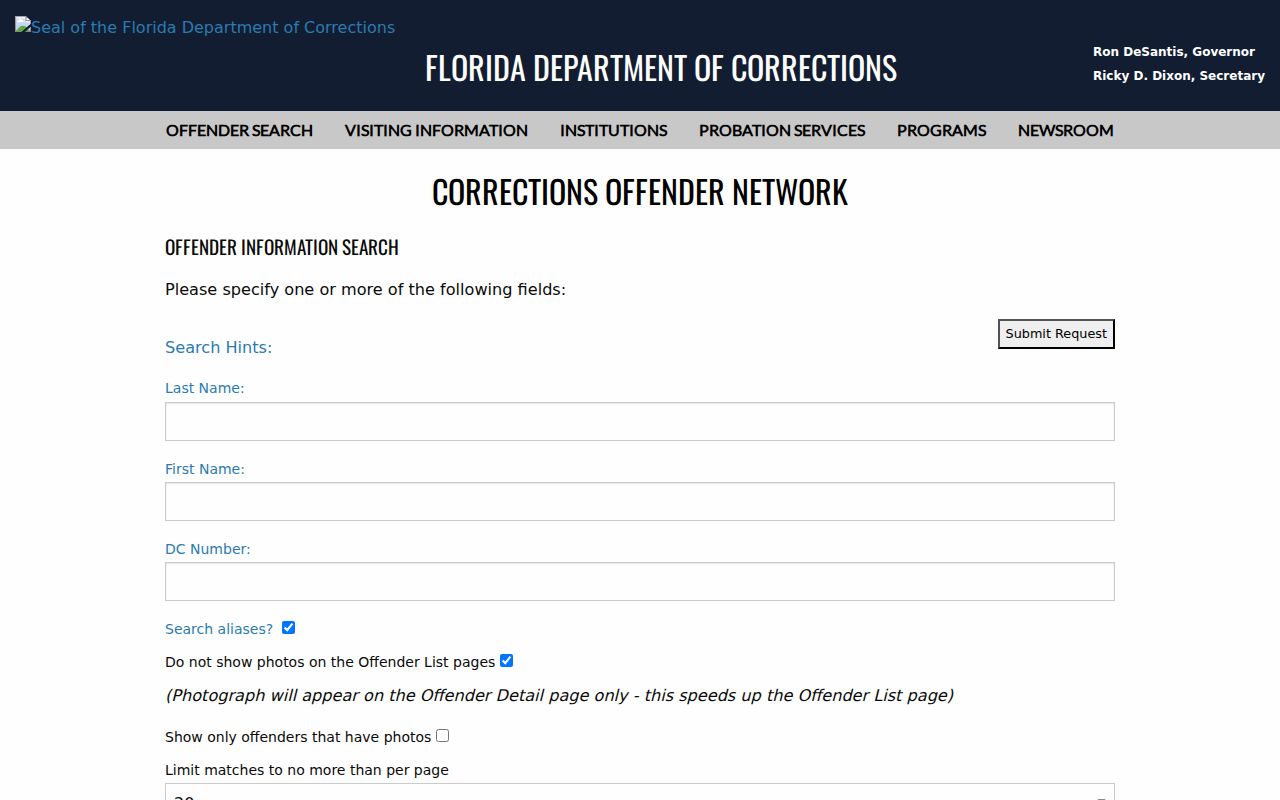
The FDC screen adds a state custody and supervision layer to local Sheriff and court records.
Inside a Calhoun County Criminal Record
A Florida repository entry is arranged around arrest cycles. It may connect names and aliases, a date of birth, demographic identifiers, a state identification number, an arrest date, the reporting agency, charges, and later dispositions. A court file is richer on procedure. It can show the charging document, counsel, hearings, motions, pleas, verdict, judgment, sentence, financial entries, and probation terms when public.
| Name and identifiers | Names, aliases, date of birth, and record numbers used to distinguish a person. |
|---|---|
| Arrest and booking | Agency, date, case or booking number, alleged charges, bond, holds, and custody changes. |
| Filed charges | The prosecutor's charges, statutes, degrees, amendments, and counts in the court case. |
| Disposition | Dismissed, nolle prosequi, acquitted, adjudication withheld, guilty, or another charge-level result. |
| Sentence | Jail, prison, probation, community control, fines, costs, or time served when entered. |
| Restrictions | Redactions, sealed or expunged material, juvenile limits, and protected document images. |
Never merge the booking charge, filed charge, and FDLE entry. They describe different stages and can differ lawfully. Read each count's newest disposition. If your own FDLE cycle is incomplete, obtain Personal Review and a certified disposition from the Calhoun Clerk, then follow FDLE Record Maintenance challenge instructions.
Calhoun County Warrant Fallbacks
No verified, complete Calhoun County active-warrant database was found. A blank web search is not proof that no warrant exists. Check with the Sheriff at 850-674-5049, review the Clerk case docket, contact the issuing court, and use FDLE Wanted Persons for qualifying statewide entries. A bench warrant or capias may appear in a docket and later be recalled, so the newest entry and direct verification matter.
Provide a full name, date of birth, case number, issuing court, and approximate date if known. A person trying to resolve a possible warrant should seek case-specific instructions or counsel before appearing at an office. Bond, surrender, recall, and hearing terms depend on the actual order. Sealed warrants will not be public, and public systems can lag after service or recall.
Warrant check flow: Sheriff status check › Clerk docket › Issuing court › FDLE qualifying statewide entry › case-specific resolution.
Public Access Laws in Florida
Florida Public Records Law generally lets a person inspect or request public agency records without explaining a motive. A Calhoun County custodian must respond promptly and in good faith, apply valid exemptions only to protected material, and provide the rest after redaction. Florida does not impose a universal ten-day deadline. Time depends on scope, retrieval, review, and redaction. Ask for an estimate before a request likely to require extensive staff or technology work.
Key Florida rules:
Florida Statutes §119.07 governs inspection, copying, fees, redaction, and exemption explanations.
Florida Statutes Chapter 943 governs criminal-history collection, dissemination, review, registry duties, sealing, and expunction.
Florida Statutes §943.0585 sets court-ordered expunction rules.
Florida Statutes §943.059 sets court-ordered sealing rules.
Active criminal intelligence, juvenile data, protected victim details, medical information, security material, and confidential identifiers may require redaction or withholding. If material is withheld, request the specific statutory citation and a written explanation. Court records also follow Florida judicial-access rules, so a paper file that is open at the counter may still have images withheld from anonymous online access.
Request Calhoun Sheriff Records
For a Sheriff incident, arrest report, booking sheet, warrant record, CAD entry, 911 audio, or body-camera segment, identify the precise item and send the request to the Sheriff custodian. Use the website contact route, mail or visit the Central Avenue East office, or call 850-674-5049 to identify the right custodian. No dedicated request form, fax, fixed turnaround, local clearance price, or general fee schedule was located in official sources.
Keep broad multimedia requests manageable. First ask for the core incident or arrest report and booking sheet. Their identifiers can support a second request for selected supplements, audio, or video. Ask for electronic production in the existing format where practical and for a cost estimate before extensive review. A Blountstown Police incident belongs with the city or police custodian, while FHP, FWC, FDLE, and federal agencies retain their own reports.
Sealed, Expunged, and Restricted Records
Florida distinguishes court-ordered sealing from court-ordered expunction. Sealing makes a qualifying record confidential from ordinary public access while preserving access for entities named by law. Expunction generally directs agencies to destroy or remove records, while FDLE retains a limited confidential record. A dismissal alone does not create either form of relief. Adult arrest history can remain public with the dismissal attached unless a legal restriction applies.
The Calhoun County path starts by preserving the arrest report, docket, certified disposition, and any proof that probation or diversion ended. Apply to FDLE for a Certificate of Eligibility with the required fingerprints, certified records, and nonrefundable $75 fee. FDLE reports an approximate twelve-week certificate review and does not expedite it. Eligibility is not relief. The petition, affidavit, certificate, proposed order, and local papers must then be filed with the Calhoun Clerk, and the judge retains discretion.
The FDLE seal and expunge process controls certificate requirements and current timing.
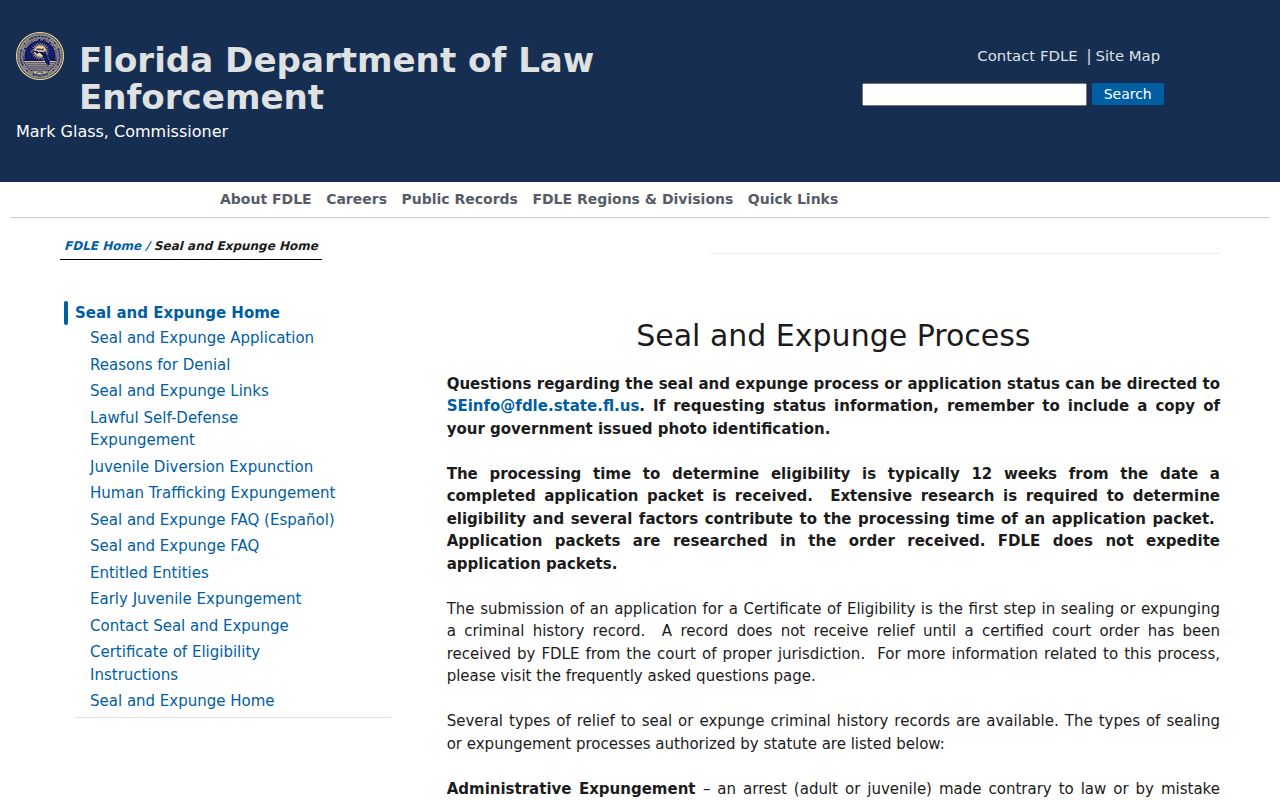
Preserving certified source records before relief helps with later correction, eligibility, and proof of the court's action.
Calhoun County FDLE Registry Search
The Florida Sexual Offenders and Predators Search is the authoritative Florida registry. A countywide query can leave names blank and select Calhoun County. A neighborhood search accepts an address, city, ZIP code, and a radius offered by the live form. Profiles can show designation, status, photographs, aliases, public addresses, qualifying offenses, sanctions, supervision, vehicles, identifying marks, and tracking tools as allowed by law.
The registry is not a person's full Calhoun County criminal history. Florida displays legal designations of sexual offender and sexual predator rather than using federal Tier I, II, and III as its main public labels. Address and status data can change fast. Verify a current concern through FDLE or the Calhoun Sheriff, and report suspected noncompliance instead of confronting anyone. Florida law makes misuse of public registry information a first-degree misdemeanor.
Calhoun County Supervision Records
Adult felony probation and community control are mainly supervised by Florida Department of Corrections Community Corrections. The Calhoun County court case shows whether supervision was imposed, and FDC Offender Search may display a public supervision or release status. Detailed officer assignments, treatment facts, conditions, and risk information are not necessarily public. For misdemeanor supervision, start with the County Court judgment because the sentencing court's arrangement controls.
The Florida Commission on Offender Review handles parole and specified release decisions, while FDC generally performs field supervision. A sound check compares the Calhoun judgment or probation order, FDC search, the Community Corrections office serving the county, and Commission records where parole or conditional release is involved.
The Florida Commission on Offender Review explains the state release authority.
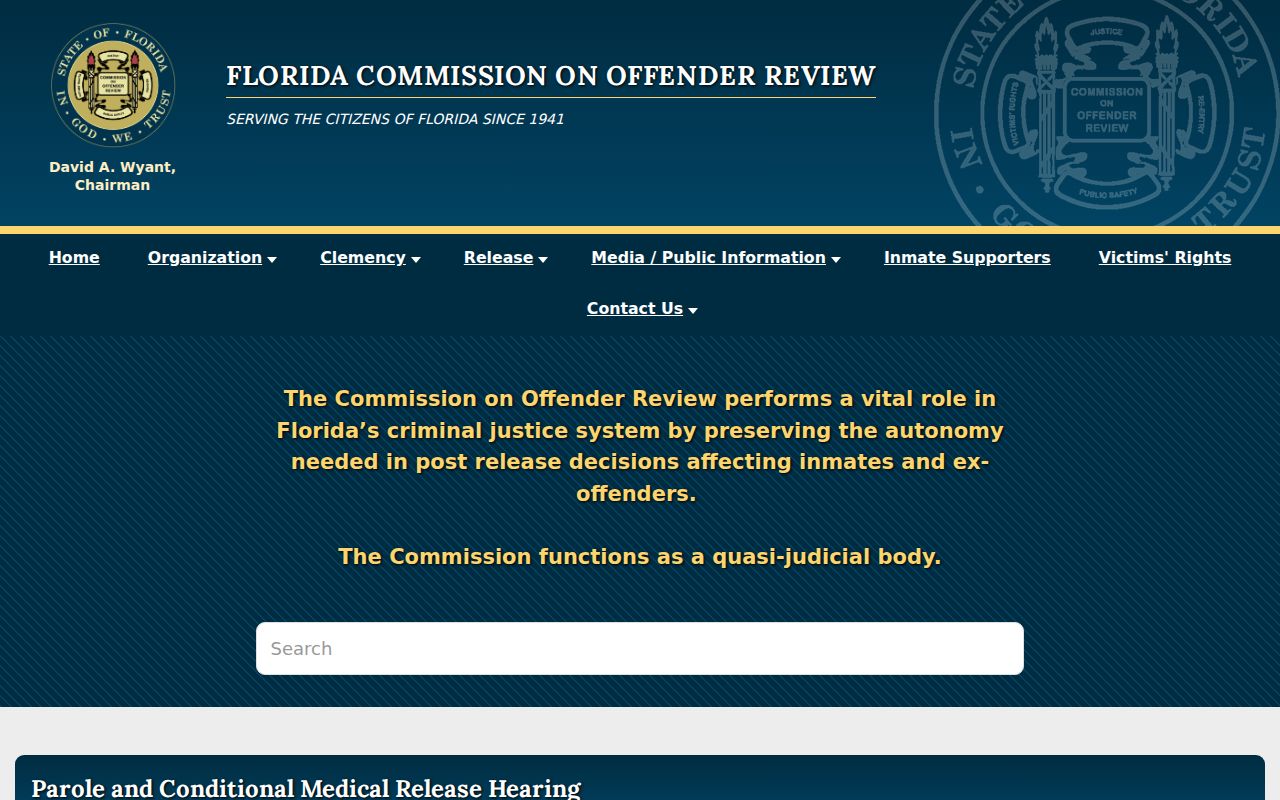
This state layer should be read with the sentence recorded in the local court file.
Calhoun County Courthouse Record History
Historical research can point to a different building from today's criminal-record counter. Calhoun County's early seats followed river settlements. Blountstown became the county seat, the old courthouse was commissioned in 1904, and the current courthouse was occupied in 1973. The historic building at 314 East Central Avenue is not the identified Room 130 counter for current criminal case files.
Older cases may also have paper or archival limits that a modern online portal does not explain. Ask the Clerk about the date range, storage, and image coverage instead of assuming every old filing was digitized. The county courthouse history illustrates why the record's era matters.
The historic courthouse is valuable context, but current case searches and copy requests belong at the operational courthouse and Clerk.
Calhoun County's Six-County Circuit
Calhoun County Circuit Court hears felonies, while County Court handles misdemeanors, county ordinance matters, and criminal traffic. Both operate within Florida's Fourteenth Judicial Circuit, which also covers Bay, Gulf, Holmes, Jackson, and Washington Counties. The State Attorney and Public Defender are circuit offices, not agencies created by Calhoun County. That structure explains why a prosecutor, defense office, judge calendar, or appellate step may use a regional site even though the Clerk holds the local case file.
The Fourteenth Judicial Circuit provides judicial and calendar context.
Use the Calhoun Clerk for the county docket and the circuit source for the wider judicial framework.
Calhoun County Criminal Records by City
Calhoun County has only two incorporated municipalities. Blountstown is the county seat and has a municipal police department, so city incident reports start with the city or police custodian before bookings and cases move to county channels. Altha has no separate police department or municipal court portal found in official sources, which makes the Sheriff and Clerk the practical record route. Unincorporated communities are not added merely to fill a third city slot.
Blountstown Criminal Records
2020 population 2,266. City police reports route to the city, while jail and court records route through Calhoun County.
Altha Criminal Records
2020 population 496. Sheriff law enforcement and county court routing replace a separate town police or case portal.
These two city paths reflect who created each record. A city boundary does not move the filed criminal case out of the Calhoun Clerk's system.